Electrical Wall Outlets look simple, until a plug will not fit or a device needs more power. For global buyers, the right choice depends on destination, voltage, frequency, grounding, current rating, and installation conditions. A familiar faceplate can hide important differences.
Electrical educator Mike Holt is known for teaching practical electrical safety. A buying principle consistent with that approach is: “Choose the outlet for the circuit, room, and user—not for appearance alone.” This is an editorial paraphrase, not a verbatim quotation. It points to a real purchasing risk: selecting a socket by shape alone may overlook compatibility or safety requirements.
This guide explores common outlet types found across international markets, including Type A, C, G, and I designs. It also considers grounded and ungrounded models, USB-integrated outlets, and options suited to kitchens, offices, and hospitality settings. A buyer comparing samples should inspect the pin layout, shutter design, terminal access, and material quality. Look closely.
Market needs vary. A compact two-pin outlet may suit one product range, while a grounded model may be essential for another. National standards and local installation rules differ, so buyers should verify requirements with qualified local professionals before specifying products. Details matter. Still, a product sheet cannot show everything; tactile fit, finish consistency, and clear labeling deserve a closer review. This overview offers a grounded starting point, not a substitute for technical validation.
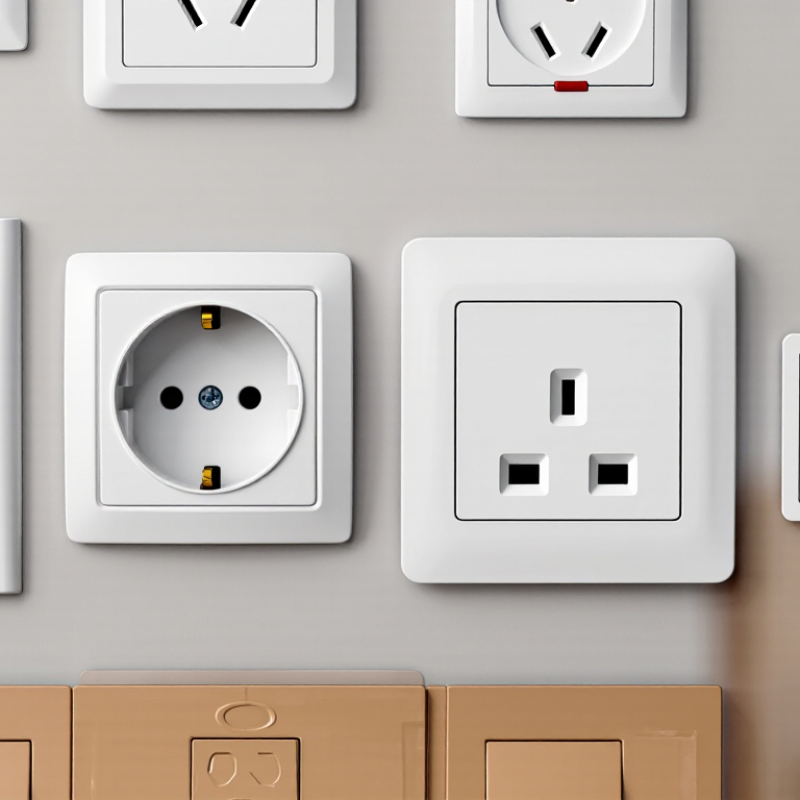
2026 Top Electrical Wall Outlet Types for Global Buyers
How Electrical Wall Outlets Differ by Plug Shape and Pin Layout
A wall outlet’s shape gives buyers a useful first clue, but it does not tell the whole story. Type A and B plugs use flat pins; Type B adds a grounding pin. Type C typically has two round pins, while Types E and F use round pins with different grounding arrangements. Type G has three rectangular pins, and Type I uses angled flat pins. These visible details help with identification.
Pin layout affects whether a plug fits securely and whether grounding is supported. Still, similar-looking plugs may have different dimensions or grounding features. Outlet configurations can also vary within a region. A quick visual check can miss important details, so compare the product’s stated plug type, voltage, and frequency with the outlet and local supply. Never assume that a matching shape guarantees electrical compatibility.
Tips: Check the label. Confirm the pin layout and grounding details before purchasing equipment for another country. If markings are unclear, ask a qualified electrical professional. It can feel tedious, but appearance alone is not a reliable specification.
| Plug Type | Pin Shape and Layout | Grounding Arrangement | Common Markets | Typical Mains Supply | Buyer Considerations |
|---|---|---|---|---|---|
| Type A | Two parallel flat pins | Not grounded | United States, Canada, Mexico, Japan | Varies by country; commonly 100–127 V, 50 or 60 Hz | Check plug polarity and local outlet requirements. A Type A receptacle does not provide an earth connection. |
| Type B | Two parallel flat pins with a round grounding pin | Grounding pin connects to the protective earth system | United States, Canada, Mexico, Japan | Varies by country; commonly 100–127 V, 50 or 60 Hz | Confirm grounding compatibility and applicable current rating; receptacle designs and standards can differ by market. |
| Type C | Two round pins | Not grounded | Common across parts of continental Europe, Asia, Africa, and South America | Varies by country; commonly 220–240 V, 50 Hz | Often associated with smaller, unearthed appliances. Compatibility with a wall outlet depends on the local socket design. |
| Type D | Three round pins arranged in a triangle, with a larger earth pin | Grounding pin | India, Nepal, and some neighboring markets | Commonly around 230 V, 50 Hz | Do not assume compatibility with Type M: pin dimensions and ratings differ. |
| Type E | Two round pins; the compatible plug has a socket for the outlet’s earth pin | Earth pin projects from the receptacle | France, Belgium, Poland, Czechia, Slovakia, and other markets | Commonly 220–240 V, 50 Hz | Check the required E or E/F-compatible receptacle design and local grounding requirements. |
| Type F | Two round pins | Grounding contacts are metal clips on the sides of the plug and socket | Germany, Austria, the Netherlands, Spain, and other markets | Commonly 220–240 V, 50 Hz | Often called Schuko. Check side-earth compatibility; some outlets accept both Type E and Type F plugs. |
| Type G | Three rectangular pins arranged in a triangle | Longer top pin operates the earth connection and shutter mechanism | United Kingdom, Ireland, Malta, Cyprus, Singapore, and Malaysia | Commonly 220–240 V, 50 Hz | Many plugs include a fuse. Verify the required socket standard, shutter design, and local fuse requirements. |
| Type I | Two angled flat pins; grounded versions add a vertical earth pin | Grounding pin on grounded versions | Australia, New Zealand, China, and Argentina | Commonly 220–240 V, 50 Hz | Confirm the destination market’s pin dimensions and current rating; national standards may vary. |
| Type J | Three round pins in a triangular layout, with the earth pin offset | Dedicated grounding pin | Switzerland and Liechtenstein | Commonly 230 V, 50 Hz | Check Type J compatibility. A two-pin Type C plug may fit some outlets, but it does not provide grounding. |
| Type L | Three round pins in a straight line | Center pin provides grounding | Italy, Chile, and some other markets | Commonly 220–230 V, 50 Hz | Several pin-spacing and current-rating versions exist; confirm the exact local socket configuration. |
| Type M | Three large round pins arranged in a triangle | Large top pin provides grounding | South Africa and some markets in South Asia | Commonly 220–240 V, 50 Hz | Designed for higher-current applications in some installations. Do not treat it as interchangeable with Type D. |
| Type N | Three round pins in a triangular layout | Dedicated grounding pin | Brazil and South Africa | Varies by country and region; Brazil has both 127 V and 220 V systems | Check the local voltage, current rating, and adopted standard. Socket appearance alone does not indicate supply voltage. |
Important: Plug type identifies physical pin configuration, not the voltage or frequency supplied by a wall outlet. Standards, ratings, and installed socket designs can vary within a country. Confirm local electrical codes and product specifications before sourcing or installation.
No. Plug shapes, grounding, voltage, and frequency vary by region.
They are common in the United States, Canada, and parts of Central America. Japan also uses Type A.
No. Type C, E, and F configurations are common in different areas. Older buildings may differ.
No. It changes the connection shape only. Check the device label.
Confirm its voltage range matches the supply. Also check the outlet’s current rating and grounding.
Many supplies are around 100–127 V or 220–240 V. Frequency can vary too.
No. Ratings such as 10 A, 13 A, 16 A, and 20 A depend on the outlet design.
Not always. Hotels and renovated rooms can differ. I would not trust a country map alone.
A qualified local electrician can check its voltage, current, grounding, and installation. Details matter.
Electrical Wall Outlets vary in shape, pin arrangement, grounding design, and dimensions, so a plug that fits in one country may not work in another. Regional standards determine which outlet types are commonly used, while local electrical systems also differ in voltage and current ratings. Buyers should compare these details with the plugs and equipment intended for use, rather than choosing an outlet based on appearance alone.
Before selecting an outlet, check its rated voltage and current, grounding method, terminal design, and relevant safety features, such as protective shutters where appropriate. Consider the installation environment, the number and type of connections needed, and whether the outlet is compatible with the local wiring system. A careful comparison of regional standards and product specifications can help global buyers choose a suitable outlet configuration and support safe, reliable use.

 Huaya Electric